Powering Wearables with Body Heat: Commercial Peltier TEGs
Can off-the-shelf Peltier modules run a wearable ECG on body heat alone? I tested 4–6 modules on the forearm. Heat sinks mattered far more than adding modules.
Lucas Chiang 1 views
The problem
Wearable health devices like ECG monitors need constant power, and batteries mean charging, replacing and waste. Your body is always giving off heat, and thermoelectric generators (TEGs) turn a temperature difference directly into electricity.
Research TEGs made for the body exist, but they're custom and expensive. I wanted to know whether cheap, mass-produced 40×40 mm Peltier modules could harvest enough body heat to keep a low-power wearable running continuously.
What I built
A body-heat harvesting test rig and a charging circuit:
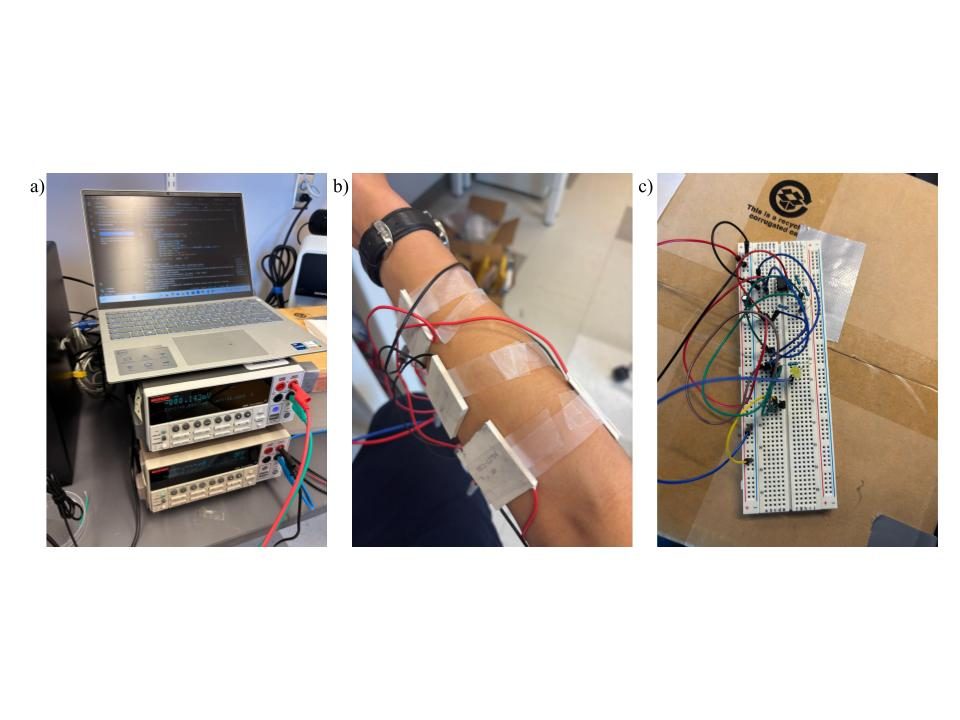
- An array of commercial Peltier TEGs wired in series and taped to the forearm, tested as 4, 5 and 6 modules, and 6 modules with heat sinks
- A data-logging setup: a Keithley 2401 SourceMeter read by a Python script, with every run exported to Excel for analysis
- A capacitor-charging simulation and a breadboard circuit, to see whether the harvested energy could charge a storage capacitor far enough to power a device
How it works
A TEG produces voltage when one side is hotter than the other. Here the hot side is skin (about 34°C) and the cold side is room air. I set the room temperature for a 17 K difference between body and room.
Protocol
- Four configurations: 4, 5 and 6 TEGs in series, plus 6 TEGs with heat sinks on the cold side
- 3 trials of 5 minutes each per configuration
- Without heat sinks, I pressed the modules to the skin with a non-conductive surface so contact stayed consistent
- The Python script logged voltage continuously; I averaged the last 30–60 seconds, once readings had stabilized
Energy storage
- I modeled charging with Vc(t) = Vs(1 − e^(−t/RC)) for 5.5 V capacitors of 10, 22, 47 and 100 µF through 1 kΩ, with a controller that discharges at 3 V to power the device
- I then built the circuit on a breadboard to test it with real TEG output
Analysis
- Two-tailed t-tests between each pair of configurations, to see which changes actually made a statistically significant difference
Results
Stabilized output (17 K body–room difference, 3 trials each):
- 4 TEGs: ~0.068 V
- 5 TEGs: ~0.074 V
- 6 TEGs: ~0.098 V
- 6 TEGs + heat sinks: ~0.172 V (about 75% higher, p = 0.0013)
Peak output reached ~0.16–0.18 V, about 26 µW. An ultra-low-power ECG needs roughly 30 µW, so this setup comes close but falls short.
Charging: after ~224 seconds, the 10 µF capacitor had reached only ~0.004 V, so charging to 5.5 V wasn't feasible with commercial modules and no boost converter.
Published in the Oxford Journal of Student Scholarship, Vol. 8, No. 2 (June 2026), pp. 217–229.
What I learned
- More modules is not the answer. Going from 4 to 6 TEGs raised the voltage a little, but none of those differences were statistically significant (p = 0.81, 0.12, 0.11).
- Thermal management is. Heat sinks raised output about 75% (0.098 V → 0.172 V, p = 0.0013). Without them, the cold side warms up to match the skin, the temperature difference collapses, and the voltage drops and settles lower.
- Commercial Peltier modules are designed for large industrial temperature differences, not the few degrees you get between skin and air. A part designed for the wrong operating conditions will underperform no matter how many you add.
- Practical lessons: modules shift on a moving arm, and contact pressure changes the readings a lot. Controlling the setup mattered as much as the electronics.
What I'd improve next
- Redesign the whole thermal system instead of stacking modules: heat-spreading layers, better thermal interface materials, and a real heat-dissipation path
- Try materials made for small temperature differences: thin-film, flexible, or organic/inorganic composite TEGs, while keeping them cheap enough to sell
- Add a boost converter so low voltages can actually charge storage
- Test more subjects, more module counts, and a mounting that doesn't shift during movement
Discussion (0)
Sign in to join the discussion.